Course Contents
Expected prior knowledge: Experience with a discrete-event simulation environment such as Arena, Simio, Tomas, Salabim, or an agent-based simulation environment such as MESA or NetLogo. Basic knowledge about probability theory and statistics.
System Theory, Object Orientation, Discrete Event System Specification, Multi-Formalism Simulation, Real-Time Distributed Simulation, and Simulation Language selection will be the core topics of the course. After an introduction to system theory, the inner working of simulation environments will be illustrated on the basis of the DEVS, DESS, and DTSS formalisms. Then, possible integrating of the different formalisms will be shown. Several special topics will be taught, based on the latest research in simulation. This material will be illustrated in intensive and interactive courses.
In addition to the lecture topics, several other simulation topics will be studied by groups of students, who will write a scientific paper, and present their findings in class. These topics can be focused on the MSc program that the students participate in; special topics to study are available for TIL, CoSEM, EPA, Computer Science, and other students.
Finally, groups of students will study a simulation package in-depth and discuss the commonalities and differences with other packages. Again, the package chosen can be targeted at the MSc program of the students. TIL students can, e.g. study a package that is more aimed at logistics and transport, CoSEM students can focus on a package that is used in systems design, whereas EPA students can focus on a package used in policy analysis.
This course requires active participation and contains group work.
Target group: Students in EPA, CoSEM, TIL, TEL, PEL, Computer Science, and any other MSc student with some prior knowledge about computer simulation, and basic knowledge about probability theory and statistics.
Extra Skills Trained: Writing a high-quality scientific paper; exploring a new simulation language / package
Elective: Yes
Learning Objectives / Outcomes
After taking this course the student will have knowledge about:
- systemic principles behind simulation, and clear understanding of key terms, such as state, time, transition, event, process, and activity;
- internal working of different kinds of discrete event simulation languages and environments, with a focus on state transitions over time;
- underlying theories and formalisms of discrete event simulation, such as DEVS, DTSS and DESS;
- the DEVS paradigm, including state trajectories and transition functions; quantized DEVS (QDEVS); discretized time; Dynamic Structure DEVS (DSDEVS), and other DEVS variants;
- transformation between simulation formalisms; the formalism-transformation graph;
- object-oriented simulation environments; service-based simulation;
- structure and abilities of distributed simulation; the concept of HLA to manage time and state in distributed simulations; classes of functions in a distributed simulation environment;
- latest research activities in the field of simulation, with research topics like web-based simulation, real-time control using simulation, agent based simulation, interactive simulation and gaming, and simulation in special domains;
- examples of successful and less successful simulation studies and the learning experiences of those studies;
- important similarities and differences between simulation languages, and selection methods for simulation packages.
Practical skills will have been developed with respect to:
- usage of at least one simulation package that was previously unknown;
- writing of a scientific paper on the topic of simulation.
Insight will have been gained on:
- comparing and contrasting simulation languages;
- the importance of time and state relationships for any type of simulation modeling;
- the formal foundations of the simulation domain.
Education Method:
Lectures about state-of-the-art simulation theory; Studying one discrete-event or agent-based simulation package in-depth per group; Paper writing by student groups on a special topic; Lectures by student groups on their special topic.
Please find attached Course Program: Course Program SEN9110 2024-2025.pdfAssessment:
The mark for this course will be based on the result of group assignments (paper, presentation, lab study of simulation package) and on an individual written exam or individual essay. The exam / essay will count for 50%, the group paper (including the class presentation) for 30% and the study of the simulation package for 20%. Each of the marks has to be 5.75 or higher to be included in the final mark.
Permitted Materials during Exams / Essay Writing
All written materials are allowed during the exam / essay writing: papers, class notes, slides.
Literature and Study Materials
|
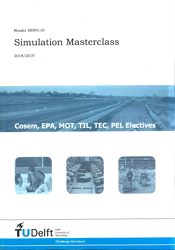
Set of scientific papers and book chapters that will be made available through this website. Typically, every class you will have on average 2 papers to study for the exam. The SEN9110 Reader with the paper for the exam is available through the TU Delft Reader shop. You can order on-line at: https://www.webedu.nl/bestellen/tudelft/?action=order&og=2126. Search for SEN9110 and you will find the reader. The e-version is free; the paper version (ideal for the written exam) has a price of around 23 Euros. You can also download the reader directly from this website: SEN9110_Reader_2019-2020_A4.pdf As the exam may be open-book and will use the papers collected in the reader, acquiring the reader is recommended for the written exam. If you have the reader, you can also take notes during the lectures on the papers in the reader, and highlight important parts. |
Computer Use
Each group of students will study and evaluate a discrete-event or agent-based simulation package. Examples are Simio, Arena, Enterprise Dynamics, Plant Simulation, AnyLogic, AutoMod, ProModel, DSOL, Netlogo, and Symphony. Also here, the simulation package to study can be specifically adapted to the group of students.